Friday, September 8, 2023
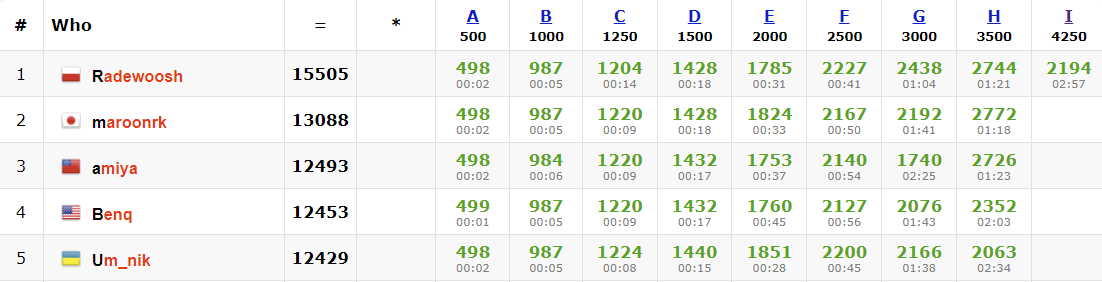
AWTF22 day 1
Wednesday, September 6, 2023
AWTF22 taifun
So, maybe people with experience of Tokyo winds can share: how bad can it be?
In general, my approach to this trip is to avoid jetlag by living more or less on Swiss time. The contests start at 6:00 Zurich time, which is definitely early, but not outrageously so. Given that I'm here for just 4 days, it seems logical to not bother shifting the schedule by much, and to sleep 20:00-5:00 Swiss time (=3:00-12:00 here).
One of the benefits is that I get to do sightseeing in the evening, when it is much more pleasant outside, and there are less people everywhere. The flip side of this coin is that many places will be closed at night.
One particularly important challenge is getting food. Lunch happens during dinner time here, so it is not really an issue. I will be late for the hotel breakfast, but it will already be lunchtime, which means that I can get some lunch food in one of the cafes near the Shinjuku station (not sure if the lunch in the hotel restaurants will be quick enough to be in time for the contests). However, what to do about dinner? Any suggestions about where to eat in Tokyo at 1am? Bonus points if your suggestion comes in the next 2 hours ;)
AWTF22 arrival
The competition itself takes place on Friday and Saturday, with two five-hour rounds currently scheduled. I do not know if those are just placeholders, but if not, that is quite a challenge for an individual event. I have a feeling that recently I do not get any problems accepted after the 2 hour mark in contests that last longer than 2 hours, so I will have to do very well in the first 2 hours of each day :)
Sunday, September 3, 2023
A Yoneda week
Sunday, August 27, 2023
An onsite week
Sunday, August 20, 2023
An arborescence week
The first step is to notice that all edges are of three types: type 2 are the edges where both ends have the same color as the edge, type 1 are the edges where one end has the same color as the edge, and type 0 are the edges where no end has the same color as the edge. We will also direct the type 1 edges from the vertex of the correct color to the vertex of the wrong color.
Clearly type 2 edges are the most useful for reaching our goal. In fact, if every vertex has at least one type 2 edge adjacent to it, then we can simply find the spanning forest among the type 2 edges. If it is a spanning tree, then we have solved the problem. If it is not connected, since we have already satisfied the color constraints, we can augment the forest to a tree using the remaining edges in any way.
What if there are some vertices that do not have type 2 edges adjacent to them? If there is a vertex with no outgoing type 1 edges, or in other words a vertex where all adjacent edges have the wrong color, then there is clearly no solution. So we only have to consider the case where some vertices have type 2 edges adjacent to them, and all remaining vertices have at least 1 outgoing type 1 edge. We will call the vertices with type 2 edges adjacent to them type 2 vertices, and the ones without them type 1 vertices.
The key remaining observation is that we cannot solve the problem using only type 1 edges. Each type 1 edge satisfies the color constraint for 1 vertex, but overall we have n vertices but only n-1 edges. So a logical idea is to start with the spanning forest of the type 2 edges that will cover all type 2 vertices, and then repeatedly try to find a type 1 edge that goes from a yet uncovered vertex to an already covered vertex (building something similar to an arborescence). If we manage to cover all vertices this way, then we can once again augment the resulting forest to a tree using the remaining edges. If we get stuck at some point, then there is no solution.
But why is this correct? We have proven that we need at least one type 2 edge, but why is it always correct to take ~all of them? This is a very typical situation for problems involving the spanning trees, as they all usually end up relying on some kind of greedy argument, so one could just bet on intuition here in my opinion. Still, here is the formal proof: consider the situation where our solution gets stuck. At this moment, the set S of uncoverted vertices contains only type 1 vertices, and there is no type 1 edge going from this set to the set of covered vertices. But then how could S be covered in any other solution? Since we have at most |S|-1 edges within S, and only edges within S can cover its vertices, one of them will have to remain uncovered in any tree.
Thanks for reading, and check back next week!
Sunday, August 13, 2023
An apiad week
I was one of those starting with the four easier problems. Somewhat unexpectedly, I did not get stuck in them and did actually have a bit more than an hour remaining for E, and made some significant progress on paper: I realized that if the sum of all ai is zero, and the sum of all bj is zero, and we can place the n2 negated sums -(ai+bj) in the matrix in such a way that every column and row has exactly one of each ai and bj, then the sum of the 2n-1 cells in a cross, which is the sum of the row plus the sum of the column minus the middle cell, will be exactly ai+bj. I've then realized that if the sum of all ai plus the sum of all bj is divisible by 2n-1, then we can get both of those sums equal to zero with some constant shifts. Finally, I've correctly hypothesized that in case it's not divisible by 2n-1, then we can only achieve score n2-1, and figured out how to do so with some more constant shifts for the first row and the first column.
Therefore the only remaining step was to place the n2 negated sums -(ai+bj) in the matrix in such a way that every column and row has exactly one of each ai and bj. This does not depend on the values of a and b, so this simply needs to be done once for every n. It seemed quite doable as it felt like a more advanced derangement, and derangements are quite dense. I've tried some random placements and noticed that I can find such a placement for odd n, but not for even n. And this is pretty much how far I've got in an hour :)
Judging from the editorial (which I do not understand), it seems that for even n we need to use more degrees of freedom, therefore while I enjoyed coming up with my approach, I needed another huge step to finish the solution, and therefore needed at least another hour.
I found problem B to be a cute test of how well one understands the spanning tree mechanics (it is amazing how many nice problems can be derived from a relatively simple concept of a spanning tree, and the fact that it can be found greedily!): you are given a connected graph where each edge is either red or blue, and each vertex is also either red or blue. You need to find a spanning tree in this graph such that for each vertex it has at least one adjacent edge of the same color as the vertex, or report that there isn't any. Can you see a way to do it?
Thanks for reading, and check back next week!